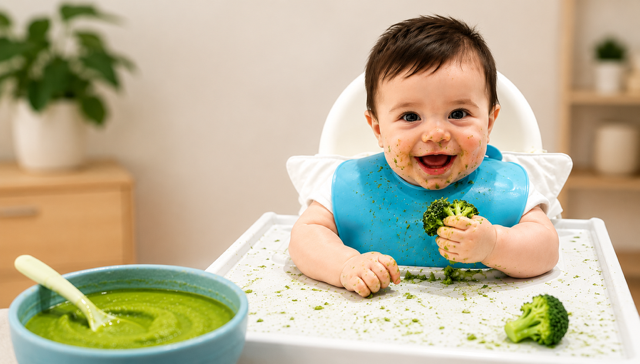
When I started solids with my first baby, I did what almost every Australian mum I know did first: I bought baby rice cereal to try. Sweet, soft, easy. It’s what the supermarket aisle suggests, what your mother-in-law recommends, and what most baby books show on the cover.
Then I started reading the research – and discovered I had it almost completely backwards. It’s never too late to think your approach to starting solids.
The most consistent finding across modern infant feeding research isn’t about when to start solids (the guidelines on that are clear). It’s about what to start with. And the evidence points in a very specific direction that almost no commercial baby food brand wants to talk about: babies who are introduced to bitter green vegetables first (as per registered Dietitians and the research), repeatedly, and early in the solids journey are significantly more likely to eat vegetables as toddlers, preschoolers, and even at age six and beyond.
This is the guide I wish I’d had – covering when to start, how to recognise readiness, why bitter greens matter so much, and a simple spinach and broccoli puree recipe based on the research to start with.
Ok so let’s get into it.
As an Amazon Associate I earn from qualifying purchases. This article contains affiliate links. If you buy through them, I may earn a small commission at no extra cost to you. I only recommend products I genuinely use and trust. Read my full Affiliate Disclosure. I’m not a healthcare professional. This article reflects my personal experience and research, not medical advice. Please consult a qualified provider about your specific situation. See my full Medical Disclaimer.
What We’ll Cover
If you’re skimming (no judgement, I would too), here’s everything in this guide:
- When to start solids (and why “around 6 months” is more specific than it sounds)
- The developmental signs of readiness – all of them, with the science
- Why bitter green vegetables make the best first foods (the research no one tells you)
- The “8 exposures” rule that changes everything
- A research-backed spinach and broccoli puree recipe
- Iron, allergens, and the Australian first-foods framework
- The essential starting solids kit (what you need)
- What NOT to do (common starting solids mistakes)
Grab a cuppa. This is the one you’ll want to bookmark.
A Quick Note on Evidence and Trust
The research below draws on Australian clinical guidelines (NHMRC Infant Feeding Guidelines 2012, NSW Health, Queensland Health), the World Health Organization, and peer-reviewed studies from the Monell Chemical Senses Centre (Mennella, Beauchamp), the University of Leeds (Hetherington, Caton), and the Baby’s First Bites RCT (Wageningen University). I’ve named the sources later in the article so you can read them yourself.
If your baby has reflux, allergies, prematurity, growth concerns, or any medical complexity, please follow your paediatrician, dietitian, or child health nurse’s advice over a blog post. Together you and they know your baby. I don’t.
When to Start Solids: What the Australian Guidelines Actually Say
The NHMRC Infant Feeding Guidelines (2012, the current Australian standard) and the World Health Organization recommend introducing solid foods around 6 months of age. Not before 4 months. Not at 4 months “to help them sleep.” Around 6 months.
The “around” is important. Some babies are ready at 5½ months, others closer to 7. The age is a guide; the developmental signs (below) are what matter.
Why Not Earlier?
Before about 6 months, most babies are not developmentally ready for solids. Their digestive systems are still maturing, their immune systems are producing less of the IgA antibodies that protect the gut lining, and their tongue-thrust reflex (which automatically pushes foreign objects out of the mouth) is still strong.
Introducing solids too early has been associated with:
- Reduced breast milk or formula intake (and therefore reduced nutrition from the most nutrient-dense source)
- Higher rates of respiratory infections and eczema in some studies
- Increased load on immature kidneys
- Constipation
- Higher long-term risk of obesity in some observational data
Why Not Later?
Waiting much beyond 6–7 months also has risks:
- Iron stores deplete. Babies are born with iron stores that last roughly 4–6 months. After that, they need iron from food. Iron deficiency in the second half of infancy is associated with developmental delays.
- The “flavour window” starts to close. This is the part most parents don’t know about. The first few months of complementary feeding appear to be a uniquely receptive period for accepting new flavours, including bitter ones. We’ll get to this.
- Texture acceptance becomes harder. Babies who don’t experience varied textures by around 9 months are more likely to become fussy eaters or struggle with lumpy food later.
So: around 6 months, give or take a few weeks, when your baby shows the signs of readiness.
The Developmental Signs of Readiness
The NHMRC guidelines and Australian child health nurses look for these specific signs. Your baby should show most or all of these before you start, not just one:
1. Good Head and Neck Control
Your baby can hold their head steady and upright without support. This is non-negotiable – without it, swallowing safely is genuinely risky.
2. Can Sit with Minimal Support
They don’t need to be sitting independently yet, but they should be able to sit upright in a highchair or supported seat without slumping. If their head is flopping forward, they’re not ready.
3. Lost the Tongue-Thrust Reflex
The tongue-thrust reflex automatically pushes anything that enters the mouth back out. It’s a protective reflex for younger babies who can’t yet manage solids safely. Around 4–6 months, it fades. You’ll know it’s gone when food stays in your baby’s mouth rather than being immediately pushed out.
A quick test: offer a tiny amount of a first food on a soft spoon. If they push it out with their tongue, the reflex is still active and maybe wait a couple of days/a week to try again. If they hold it in their mouth (even briefly), they’re getting closer.
4. Interested in Food
Watching you eat. Reaching for your food. Opening their mouth when a spoon approaches. Chewing motions when watching food. This is curiosity, and it matters – babies who are interested in food are easier to feed and more receptive to new flavours.
5. Can Bring Objects to Their Mouth
Hand-eye-mouth coordination is essential for self-feeding. Your baby should be able to grasp objects and bring them deliberately to their mouth.
6. Increased Appetite
Suddenly hungrier? Wanting more milk feeds than usual? This often precedes the readiness for solids by a few weeks. (Note: this alone doesn’t mean they’re ready – it must combine with the developmental signs above.)
What is NOT a sign of readiness:
- Waking more at night (sleep regressions happen for many reasons)
- Watching you eat (curiosity ≠ readiness without the other developmental signs)
- Being a certain age alone
- Being a “big” baby or a “small” baby needing to be filled up more
Why Bitter Green Vegetables Should Be Your Baby’s First Food
This is the section the formula companies, and pouch brands don’t advertise. The research is genuinely striking.
The Innate Bias Against Bitter
Babies are born with a strong preference for sweet tastes and an innate aversion to bitter tastes. This is evolutionarily protective – in nature, sweet usually means safe (ripe fruit, breast milk), while bitter often signals toxicity (poisonous plants, spoiled food).
The problem? Most vegetables – especially the nutritionally dense ones like spinach, broccoli, kale, Brussels sprouts, and silver beet – are bitter. And humans don’t naturally outgrow that bias. Australian and international data consistently show that adults under-consume vegetables, and the habit starts in early childhood.
The Flavour Window: The Science of Early Acceptance
Research by Mennella, Beauchamp, and colleagues at the Monell Chemical Senses Centre has shown that the first few months of complementary feeding represent a uniquely receptive period for accepting new flavours – including bitter ones.
The “Good Tastes Study” (published in the Journal of Nutrition, 2022) found that infants around 6–8 months of age accepted novel bitter green vegetables more readily than older toddlers offered the same foods. The researchers concluded that acceptance of bitter green vegetables may be more easily achieved early on.
Even more striking: a longitudinal study published in PLOS One (Maier-Nöth et al., 2016) followed children for six years after being exposed to initially disliked vegetables in infancy. After eight repeated exposures to a vegetable, they initially refused:
- At 15 months: 79% still liked and ate the vegetable
- At 3 years: 73% still liked and ate it
- At 6 years: the effect persisted
In other words: what you feed your baby in those first few months of solids shapes vegetable acceptance for years.
The “Vegetables First” Approach
In 2013, researchers at Wageningen University in the Netherlands published a randomised controlled trial (Barends et al.) comparing two approaches to starting solids:
- Group A: Started with vegetables only for the first 18 days
- Group B: Started with fruit only for the first 18 days
The result? Babies in the vegetables-first group ate significantly more vegetables — and tolerated more variety – at 6 months and at 12 months. The fruit-first group developed a stronger preference for sweet tastes that was harder to shift.
A follow-up RCT – Baby’s First Bites – has continued to support the principle: starting with vegetables, particularly bitter green ones, and offering them repeatedly leads to better long-term vegetable acceptance.
Why This Matters Beyond Toddlerhood
Vegetable intake in childhood predicts vegetable intake in adulthood, which predicts cardiovascular health, certain cancer risks, and overall health and mortality. Translating this for a tired parent at 6am: the puree you spoon into your baby’s mouth this week is, statistically, one of the highest-leverage health interventions you’ll ever make on their behalf.
So, no pressure. But also – green first.
The “8 Exposures” Rule
Here’s where most well-meaning parents go wrong. The same research consistently shows:
Babies typically need 8–10 exposures to a new bitter vegetable before they accept it.
But the average parent offers a new food only 3–5 times before deciding their baby “doesn’t like it.” That mismatch is responsible for an enormous amount of unnecessary vegetable rejection.
What “Exposure” Actually Means
An exposure is not necessarily a full meal. It can be:
- A small taste on the tip of a spoon
- A spoonful added to a familiar food
- Offering the food alongside something they enjoy
- A finger-food sample at family meals
A “facial reaction” of disgust on the first try is not a rejection. It’s neurologically normal. The Feeding Infants Behaviour and Facial Expression Coding System (used in published research) explicitly notes that infants who pull faces but still swallow are accepting the food, not refusing it.
The Practical Rule
If your baby pulls a face at broccoli puree on Day 1, keep offering it for at least 8 to 10 days before drawing any conclusions. Vary the presentation slightly – plain, then mixed with something e.g. pear. Don’t force, don’t pressure, just keep gently offering and stay positive at mealtimes.
Most parents are stunned by how often a “hated” food becomes a “loved” food by attempt seven.
The Research-Backed First Foods Framework
The most evidence-based approach for the first 4–6 weeks of solids in Australia:
Week 1–2: Bitter Green Vegetables, Single Ingredient
- Broccoli puree (recipe below)
- Spinach puree (recipe below)
- Silver beet puree
- Zucchini puree
- Peas (mild but green and start the habit)
Offer one new green at a time, for several days, watching for any allergic response. Don’t add salt, sugar, or honey (honey is unsafe before 12 months).
Week 3–4: Other Vegetables and Iron-Rich Foods
- Pumpkin, sweet potato, carrot, parsnip
- Iron-fortified rice or oat cereal
- Pureed lean meat (essential iron source)
- Mashed legumes (lentils, chickpeas)
- Avocado, banana, pear (introduce these after greens, not before)
Week 5–6: Texture Progression and Variety
- Mashed rather than pureed
- Soft finger foods (avocado slices, cooked carrot batons)
- Combinations (broccoli + chicken, spinach + lentils)
- A wider range of fruits
The Australian Iron-First Emphasis
NHMRC and the Australasian Society of Clinical Immunology and Allergy (ASCIA) both stress that iron-rich foods are non-negotiable from around 6 months. This is because:
- Babies’ iron stores from birth deplete around this age
- Iron deficiency in infancy is associated with developmental delays
- Iron-rich first foods include pureed lean red meat, iron-fortified infant cereals, well-cooked legumes, and tofu
The “vegetables first” research and the “iron first” guidelines are not in conflict. The practical reconciliation: lead with bitter greens for a week or two to capture the flavour window, then quickly bring iron-rich foods in alongside. By 4–6 weeks of solids, your baby should be getting iron-rich foods at least twice daily.
Allergens – Introduce Early, Not Late
The ASCIA infant feeding guidelines (updated 2020) and the landmark LEAP study now recommend introducing common allergens early (within the first few months of starting solids) to reduce the risk of food allergy:
- Peanut (smooth peanut butter thinned with water or breast milk)
- Egg (well-cooked)
- Cow’s milk products (yoghurt, cheese – not cow’s milk as a drink before 12 months)
- Tree nuts (as smooth nut butters)
- Soy, wheat, sesame, fish, shellfish
This is a meaningful change from the older advice to delay allergens. Early, repeated exposure is now the evidence-based approach for healthy infants without a family history of allergy. If your baby has eczema, an egg allergy in the family, or other risk factors, talk to your GP first.
The Recipe: Research-Backed Spinach and Broccoli First Puree
This is the puree I made first for my baby. It’s deliberately not “fancy.” There’s no garlic, no onion, no stock, no butter. Just two of the most nutritionally dense bitter green vegetables, gently steamed and pureed.
The goal is not flavour enhancement. The goal is exposure to the actual taste of broccoli and spinach, so your baby learns these flavours as normal foods, not as foods that need to be hidden in apple sauce.
Spinach & Broccoli First Puree
Makes: About 8–10 ice cube portions (perfect for freezing)
You’ll need:
- 1 medium head of broccoli (about 400g), washed
- 2 large handfuls of baby spinach (about 80g), washed
- 60–100ml of cooled boiled water, expressed breast milk, or formula (to thin)
Equipment:
- A steamer basket or steamer pot
- A baby food maker (Beaba Babycook), Nutribullet Baby, or a basic high-speed blender
- Silicone freezer trays with lids (Wean Cubes or similar)
Method:
- Cut the broccoli into small florets. Don’t discard the stems – peel and chop them; they’re sweeter than the florets and add bulk.
- Steam the broccoli for 8–10 minutes, until very tender (a fork should slide through easily).
- Add the spinach to the steamer for the final 1–2 minutes – it wilts almost instantly. Don’t overcook spinach, as it can develop a metallic taste.
- Transfer the steamed vegetables to your blender or food processor.
- Add 60ml of liquid to start. Blend until completely smooth – no lumps. The texture should be like a thick yoghurt or smooth custard for the first feeds.
- Add more liquid as needed to reach the right consistency. Younger babies (around 6 months) need smooth and slightly runny purees; older babies tolerate thicker.
- Cool to room temperature. Test a small amount on the inside of your wrist (should be lukewarm, never hot).
- Spoon into silicone freezer trays, cover, and freeze.
Storage:
- Fridge: 24 hours in a sealed container
- Freezer: up to 3 months in covered silicone trays
To serve:
- Defrost a cube overnight in the fridge, or warm gently in a small pan with a splash of water
- Never microwave – uneven heating creates hot spots
- Always test the temperature before serving
Honest expectations:
The first time, your baby may pull a face. They may push it back out. They may look at you as though you’ve fundamentally betrayed them. This is normal. Offer it again the next day. And the day after. Eight to ten times before you draw any conclusions. This is the single most important piece of advice in this article.
By around exposure 5–7, most babies start accepting it. By exposure 10, many actively enjoy it. The research is on your side.
Variations Once They’ve Accepted the Base
After a week or two of plain spinach and broccoli, you can build complexity:
- + cooked white fish (iron, omega-3)
- + cooked red lentils (plant-based iron)
- + a small amount of pear (only after they’ve accepted the plain version – don’t lead with sweetness)
- + cooked chicken thigh (heme iron)
- + a sprinkle of dried herbs like dill or parsley (gentle flavour variation)
The Starting Solids Kit: What You Actually Need
Most starting solids “essentials” lists are designed to sell you products you don’t need. Here’s the honest minimum.
The Genuine Essentials
- A safe highchair – the IKEA Antilop is the cult favourite for a reason: cheap, easy to wipe down, easy to assemble. The Stokke Tripp Trapp is the long-term investment option if budget allows.
- A silicone bib with a catch pocket – these are genuinely life-changing for cleanup. Cloth bibs are a false economy.
- A suction-bottom bowl – ezpz Mini Mat and Bumkins suction bowls stop the bowl-flinging Olympics that start around 7 months.
- Soft-tipped baby spoons – silicone-tipped, never metal. Two or three are enough.
- Silicone freezer trays with lids – for batch-pureeing and freezing. Wean Cubes and OXO Tot are reliable.
Genuinely Useful but Not Essential
- A Beaba Babycook or Nutribullet Baby — convenient all-in-one steamer/blenders. Worth it if you’ll make a lot of homemade purees. A regular blender plus a steamer basket does the same job.
- Open-top training cups – the Doidy cup is recommended by speech pathologists over spouted sippy cups for oral development.
- A splat mat – for under the highchair. Saves your floors and your sanity.
- A good baby-led weaning book – Baby-Led Weaning by Gill Rapley is the original and still the best.
Skip These
- Fancy bottle warmers and food warmers – gentle warming in a pan of warm water works fine
- Single-purpose puree pouches – fine occasionally for convenience, but homemade is cheaper, fresher, and gives you control over flavour exposure
- Baby cutlery sets in twelve different colours – two spoons is enough
- Teething biscuits and rusks – most are surprisingly high in sugar; offer real food instead
What NOT to Do (Common Starting Solids Mistakes)
Based on the research and (honestly) my own early mistakes:
- Don’t start with sweet purees as a default. Pear, apple, banana, sweet potato – these are fine foods, but leading with them reinforces the innate sweet bias and makes bitter greens harder to introduce later.
- Don’t give up after 3 tries. This is the single biggest mistake. The research says 8–10 exposures. Believe it.
- Don’t hide vegetables in fruit purees as your main strategy. Mixing is fine occasionally, but if your baby only ever encounters broccoli when it’s masked by apple, they’re not learning to like broccoli – they’re learning to like apple.
- Don’t add salt, sugar, or honey. No honey before 12 months (botulism risk). No added salt before 12 months (kidney load, taste habituation).
- Don’t force-feed. A baby who turns their head away is communicating. Try again next meal.
- Don’t pressure or bribe. Both have been associated with worse long-term food relationships.
- Don’t compare babies. Some take to solids in a week; some take six weeks of patient offering. Both are normal.
- Don’t skip iron. This is the one area where the timeline matters more than baby’s “preference.” Iron-rich foods need to be in regularly from around 6 months.
- Don’t introduce cow’s milk as a drink before 12 months (small amounts in cooking, yoghurt, and cheese are fine from 6 months).
A Note on Medical Advice
I’m a mum, not a healthcare professional. If your baby has reflux, allergies, prematurity, growth concerns, or any feeding difficulty, please follow the advice of your GP, paediatrician, or child health nurse, or call the Australian Breastfeeding Association helpline on 1800 686 268 (24/7). See my full Medical Disclaimer.
Final Thoughts
Starting solids is one of the most enjoyable, messy, frustrating, hilarious milestones of the first year. There is no perfect way to do it. Your baby will do it in their own way, in their own time, and most of what they eat in the first weeks ends up on their face, on the floor, and in your hair. Remember it’s your role to decide what, when and where to feed and your baby’s to decide how much they eat and if they eat at all. They will innately eat to their own hunger and fullness. Trust them.
But the choices you make in these first weeks matter more than most parents realise. The flavour window is real. The research on bitter greens and long-term vegetable acceptance is consistent and strong. And the “8 exposures” rule is the single most useful piece of information I can give you.
Lead with green. Offer it again. And again. And again.
If this guide helped, I’d love to hear from you. Email me at a.nourish.ad.life@gmail.com – I read every message. And if you make the spinach and broccoli puree, I’d love to know how it went. The face-pulling photos are always welcome.
You’ve got this.
— Amanda, Nest, Nurse and Nourish
Sources and Further Reading
- NHMRC. Infant Feeding Guidelines (2012). Australian Government.
- NSW Health. Starting Family Foods: Introducing your baby to solid foods (2020).
- ASCIA. Infant Feeding and Allergy Prevention Guidelines (2020).
- Mennella JA, Beauchamp GK. (2002). “Flavor experiences during formula feeding are related to preferences during childhood.” Early Human Development.
- Maier-Nöth A, Schaal B, Leathwood P, Issanchou S. (2016). “The Lasting Influences of Early Food-Related Variety Experience: A Longitudinal Study of Vegetable Acceptance from 5 Months to 6 Years.” PLOS One.
- Barends C, de Vries J, Mojet J, de Graaf C. (2013). “Effects of repeated exposure to either vegetables or fruits on infant’s vegetable and fruit acceptance at the beginning of weaning.” Food Quality and Preference.
- Hetherington MM, Schwartz C, Madrelle J, et al. (2015). “A step-by-step introduction to vegetables at the beginning of complementary feeding.” Appetite.
- Caton SJ, Blundell P, Ahern SM, et al. (2022). “Infant and Toddler Responses to Bitter-Tasting Novel Vegetables: Findings from the Good Tastes Study.” Journal of Nutrition.
- World Health Organization. Guideline: complementary feeding of infants and young children 6–23 months of age (2023).
Last Updated: 03/06/2026