
If you’re reading this, you’ve probably just realised that a wearable breast pump can mean anything from a $80 silicone catcher to a $600 hospital-grade device that fits inside your bra. And every article you’ve read so far has told you a different pump is the best one.
I get it. I went through the same spiral.
I’m a Sydney mum currently combo feeding my 3-month-old, and I’ve spent more hours than I’d like to admit researching, comparing, and asking other mums about the wearable pump market. Last time I used a breast pump for my older two children wearable breast pumps were not an option and how nice is it not to be hooked up to a large device that needs to be plugged into power. I’m loving the portability.
I’ve tested some myself, and for the others, I’ve leaned on real mums’ detailed feedback, an IBCLC’s input, and current 2026 product specifications.
This article is the honest comparison guide I wish I’d had at week three postpartum, before buying and trying to manage a leaking pump at 3am.
I’m going to tell you which pump is right for which mum, what the marketing leaves out, and where to actually buy each one in Australia (and internationally). And because I’d rather you spend $300 on the right pump than $600 on the wrong one, I’ll also tell you when a wearable isn’t the right choice and you should buy a traditional pump instead.
Ok so let’s get into it.
As an Amazon Associate I earn from qualifying purchases. This article contains affiliate links. If you buy through them, I may earn a small commission at no extra cost to you. I only recommend products I genuinely use and trust. Read my full Affiliate Disclosure. I’m not a healthcare professional. This article reflects my personal experience and research, not medical advice. Please consult a qualified provider about your specific situation. See my full Medical Disclaimer.
The Quick Picks
If you’re skimming (no judgement, I would too), here’s the short version:
- Best premium wearable for quietness and discretion: Elvie Pump
- Best premium wearable for leak-proof reliability: Willow Go
- Best mid-range / best-seller: Momcozy M9 or S12 Pro
- Best budget wearable: Momcozy M5
- Best hybrid (wearable cups + external motor): Elvie Stride
- Best traditional pump for primary use: Spectra S1 Plus
- Best for working mums: Eufy S1 Pro (newer, but worth a look)
- Best $30 silicone catcher to pair with any pump: Haakaa
If you’re an Australian mum and want the short answer for most people: a Momcozy M9 or S12 Pro for portable/discreet sessions paired with a Spectra S1 Plus for serious daily pumping at home is the combo that gives most mums everything they need without overspending.https://www.shopper.com/p/Sx8Y/r
Want the long version with reasoning? Keep reading.
What Actually Is a “Wearable” Breast Pump?
A wearable breast pump is any pump that fits inside your nursing bra so you can pump hands-free, without sitting tethered to a wall outlet with tubes and bottles hanging off you (traditional pump).
There are two main types:
Fully wireless wearables (no tubes, no external motor): The motor, milk container, and flange are all built into a single cup that sits in your bra. Examples: Elvie Pump, Willow Go, Momcozy M9.
Hybrid wearables (in-bra cups + external motor): The cups sit in your bra, but small tubes connect them to a small portable motor (clipped to your waistband or sitting nearby). Examples: Elvie Stride, Spectra CaraCups.
Why does this distinction matter?
- Fully wireless = maximum freedom, slightly weaker suction usually, more visible bulk in your bra
- Hybrid = stronger suction, less bulk under clothes, but you do have a small motor to manage
Both have their place. Most mums end up preferring one or the other based on their specific lifestyle, not based on which is “objectively better.”
What I Actually Looked For When Comparing
Every wearable pump review online ranks pumps differently because there’s no single “best” pump, there’s the best pump for you. Here are the seven things I tested or evaluated for each pump:
Suction strength, measured in mmHg (millimetres of mercury). Hospital-grade is around 250-300 mmHg. Anything under 220 mmHg may struggle for some mums.
Noise level, measured in decibels. Under 50 dB is whisper-quiet (suitable for Zoom calls). 50-60 dB is normal conversation level. Over 60 dB is noticeable.
Battery life. How many full pumping sessions you get on one charge.
Capacity. How many millilitres each cup holds before you have to empty it.
Comfort and fit. Flange sizing, tunnel length, how the cup sits in different bra types.
Cleaning. Number of parts, dishwasher-safe components, how fiddly the assembly is.
Real-world reliability. How it actually performs at 3am, in the office, in the school run.
I also weighed the things that don’t get talked about enough: replacement part availability in Australia, brand customer service, and whether the pump has an active community of users who share tips and troubleshooting.
The Detailed Comparison
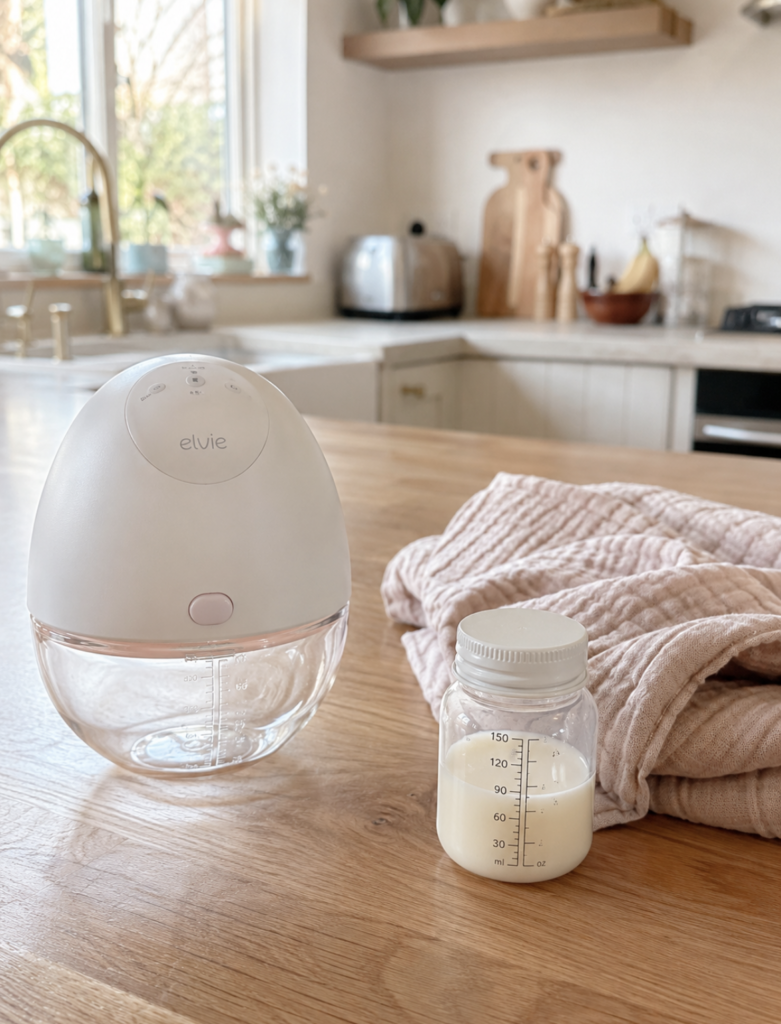
1. Elvie Pump, Best for Quietness and Discretion
The pitch: The original wearable pump, and still arguably the most refined. Smart Rhythms technology and infrared sensors automatically detect letdown and switch modes. Check current price on Amazon.
The specs:
- Suction: up to 240 mmHg
- Noise: under 50 dB (whisper-quiet, the quietest on the market)
- Battery: ~2.5 hours / 2-3 sessions per charge
- Capacity: 5 oz / 150ml per side
- Parts: 5 per cup
Where Elvie wins: No other wearable pump comes close to the Elvie when it comes to staying under the radar. It’s the slimmest and quietest electric option available, and its Smart Rhythms technology pairs with infrared sensors to sense your letdown and seamlessly shift from stimulation to expression mode on its own. If quiet matters, whether you’re working in a hushed office, hopping on video calls, or pumping somewhere noise would be disruptive, Elvie is in a league of its own.
Where it loses: Suction is moderate by 2026 standards. Newer pumps like the Momcozy M9 and Eufy S1 Pro now deliver stronger suction at lower price points. The Elvie can also be tricky to seal properly for mums with larger breasts.
Best for: Working mums in noise-sensitive environments. Mums who prioritise discretion and design over raw suction strength.
Price (AUD): Approximately $549-$649 for the double pump set.
Where to buy:
- Elvie official Australia: elvie.com/en-au
- Amazon Australia
- Baby Bunting (in-store and online)
2. Willow Go, Best for Leak-Proof Reliability
The pitch: A fully wireless wearable with spill-proof design, meaning you can lean over, bend down, or lie down without spilling milk. It’s a game changer for a multi-tasking mum. Check current price on Amazon.
The specs:
- Suction: hospital-grade, up to 280 mmHg per side
- Noise: ~55 dB
- Battery: up to 5 sessions per charge
- Capacity: 5 oz / 150ml per side
- Parts: dishwasher-safe
Where Willow Go wins: The Willow Go is a hands-free, cord-free wearable pump with hospital-grade suction reaching -280mmHg per side and a rechargeable battery good for up to 5 sessions. The leak-proof build actually matters in real life. If you’ve ever lost hard-earned mLs of milk bending down to grab a dropped burp cloth, you’ll get it. Compared to slimmer wearables like the Elvie or Momcozy M9, the Willow Go sits a little deeper in the bra, which helps it seal well for anyone with more breast tissue.
Where it loses: More visible bulk under clothing than the Elvie. Premium price tag.
Best for: Mums with larger breasts. Active multi-tasking mums (school runs, exercise, bending and lifting). Mums who want strong suction without going hybrid.
Price (AUD): Approximately $599-$699 for the double pump set.
Where to buy:
- Willow official site
- Amazon Australia
- Baby Bunting
3. Momcozy M9, Best Mid-Range Value
The pitch: A 2024-launched wearable that hits hospital-grade suction at less than half the price of Elvie or Willow, while offering app control and rapid charging. Check current price on Amazon.
The specs:
- Suction: hospital-grade, up to 300 mmHg
- Noise: ~50-55 dB
- Battery: up to 6 sessions per charge
- Capacity: 6 oz / 180ml per side
- App-controlled with custom rhythms
Where Momcozy M9 wins: Built for tech-savvy mums who want complete control over their pumping sessions, the Momcozy M9 is a standout wearable breast pump. It costs a fraction of premium options but performs right alongside the $600 models, which is exactly why it’s been the most-discussed pump in mum groups all through 2026. Like the Eufy S1 Pro, it now offers hospital-grade suction on par with traditional pumps such as the Spectra S1.
Where it loses: Quality control varies more than premium brands, some mums report needing to return their first unit. App can be glitchy on Android.
Best for: Budget-conscious mums who don’t want to compromise on suction. First-time pump buyers wanting to test wearable without going premium.
Price (AUD): Approximately $249-$329 for the double pump set.
Where to buy:
- Momcozy Australia: momcozy.com/au
- Amazon Australia
- Baby Bunting
4. Momcozy S12 Pro, Best for Elastic Nipples and Longer Tunnel Needs
The pitch: A slightly different Momcozy model with longer flange tunnels, important for mums with elastic nipples who find standard wearables uncomfortable. Check current price on Amazon.
The specs:
- Suction: up to 280 mmHg
- Tunnel length: longer than M9 (key differentiator)
- Battery: ~5 sessions
- Capacity: 6 oz / 180ml per side
Where S12 Pro wins: If you’ve got elastic nipples, meaning they stretch significantly when drawn into a pump’s flange tunnel, often leading to rubbing, soreness, or a poor fit with standard flanges, the Momcozy S12 Pro is the one I’d reach for first. Few wearables come with longer flange tunnels, but this one does, giving your nipples the space to move naturally without painful stretching or friction. For anyone who’s struggled with discomfort in other wearables, this could be the answer.
Best for: Mums with elastic nipples, larger nipples, or comfort issues with other wearables.
Price (AUD): Approximately $279-$349.
Where to buy:
- Amazon Australia
- Momcozy Australia: momcozy.com/au
5. Spectra S1 Plus, Best Traditional Pump (Your Primary Pump)
The pitch: Not a wearable, a traditional double electric pump that lactation consultants almost universally recommend as a primary pump. Check current price on Amazon.
Why I’m including a non-wearable in a wearable comparison: Because the honest truth is that most mums benefit from having both if able to. A traditional pump like the Spectra for serious daily sessions at home, paired with a wearable for portability and convenience. Going wearable-only works for some mums; it doesn’t work for many.
The specs:
- Suction: hospital-grade, 270 mmHg
- Noise: ~45 dB (very quiet for a traditional pump)
- Closed-system motor (sanitary, no milk back-flow)
- Rechargeable battery (uncommon for traditional pumps, most are wall-socket charged only)
Where Spectra wins: Lightweight but seriously powerful, the Spectra S2 Plus Premier delivers hospital-strength suction and is a lactation consultant favourite for home use. For exclusive pumpers, freezer-stash builders, or anyone battling supply issues, it outperforms most wearables.
Best for: Primary at-home pump. Exclusive pumpers. Mums building freezer stash. Mums returning to work who pump 3+ times a day.
Price (AUD): Approximately $399-$499.
Where to buy:
- Amazon Australia
- Spectra Baby Australia
- Baby Bunting
6. Eufy S1 Pro, Best for Workplace Reliability
The pitch: A newer entrant (Eufy is the smart-home brand) that’s quickly earned a strong reputation in 2026 for workplace-focused wearable pumping with heating technology. Check current price.
The specs:
- Suction: hospital-grade
- HeatFlow warming technology
- App control
- Portable charging case
Where Eufy S1 Pro wins: The Eufy S1 Pro is built for mums who need in-bra pumping through workdays, commutes, and travel. It’s made for the moments when you have to pump between meetings, on the go, or in shared spaces, no wall outlet required.
Best for: Working mums needing reliable, app-controlled, all-day wearable pumping.
Price (AUD): Approximately $399-$499.
Where to buy:
7. Haakaa Silicone Pump, The $30 Companion Every Mum Should Own
The pitch: Not an electric pump at all, a one-piece silicone “milk catcher” that suctions to your unused breast while you nurse on the other side, catching the natural letdown. Check current price on Amazon.
The specs:
- One piece, no battery, no electricity
- 4 oz / 120ml capacity
- Dishwasher safe
- Lasts years
Why I’m including it: The Haakaa is the cheapest, simplest, and most overlooked piece of breastfeeding gear. It catches the milk that would otherwise leak into a breast pad during letdown. A Haakaa user can collect 1-3 oz per feed with zero pumping effort. Over a week, that’s an entire bottle’s worth of freezer stash, free.
Best for: Every breastfeeding mum. Yes, everyone. Even if you have a Spectra and a Momcozy, the Haakaa is your $30 secret weapon for collecting passive milk.
Price (AUD): Approximately $25-$40.
Where to buy:
- Amazon Australia
- Chemist Warehouse
- Baby Bunting
So Which One Should YOU Buy?
Here’s my decision tree:
- You’re a working mum returning to work in 1-2 months, pumping 2-3 times daily → Momcozy M9 or Eufy S1 Pro for the office + Haakaa for evenings
- You’re exclusively pumping or pumping 4+ times daily → Spectra S1 Plus as your primary + Momcozy M9 as your portable
- You have a quiet office or take Zoom calls and pump → Elvie Pump (worth the premium)
- You have a tight budget but want quality → Momcozy M5 or M9 + Haakaa
- You have larger breasts → Willow Go or Momcozy S12 Pro
- You have elastic nipples or comfort issues → Momcozy S12 Pro (longer tunnels)
- You’re a first-time mum, not sure yet what kind of pumping you’ll do → Start with a Haakaa + Momcozy M5. You can upgrade later once you know your needs.
What I Wish Someone Had Told Me Before I Bought My First Pump
A few hard-earned lessons I want to share:
Flange size matters more than pump brand. A great pump with the wrong flange size will hurt and underperform. Most pumps come with 24mm flanges; many mums need 17-21mm. Get measured by an IBCLC or use a sizing kit.
Wearables work better for some breasts than others. If your first wearable doesn’t seal properly or you don’t get good output, it might not be the pump, it might be that wearables aren’t right for your anatomy. Try a traditional pump before giving up on pumping entirely.
The “free pump through health insurance” thing is mostly a US thing. Australian mums don’t get free pumps through Medicare. Some private health funds offer rebates, check yours before buying.
Quality replacement parts matter. Cheap pumps with hard-to-find replacement parts will frustrate you. All the pumps in this article have decent Australian parts availability.
You don’t need every accessory. Skip the carry bags, the bottles with custom adapters, and the “starter kits.” Buy the pump, some breast milk storage bags, and a basic cooler bag. That’s it.
A Note on Medical Advice
I’m a mum, not a healthcare professional. If you have concerns about milk supply, pain while pumping, or any feeding issue, please contact a qualified IBCLC, your GP, or the Australian Breastfeeding Association helpline on 1800 686 268 (24/7). See my full Medical Disclaimer.
Bottom Line
If I could only recommend ONE wearable pump to a mum starting out: Momcozy M9. It’s the best balance of price, performance, and reliability in 2026, and most mums don’t outgrow it.
If I could recommend ONE traditional pump alongside it: Spectra S1 Plus. It’s the gold standard primary pump.
If I could recommend ONE accessory regardless of which pump you choose: Haakaa silicone pump. $30 and worth its weight in milk.
Total spend for the trio: about $670 AUD. That’s less than the price of a single Elvie or Willow, and most mums find it covers everything they need.
Best wishes with your pumping.
— Amanda, Nest, Nurse and Nourish
Last Updated: 22/05/2026